
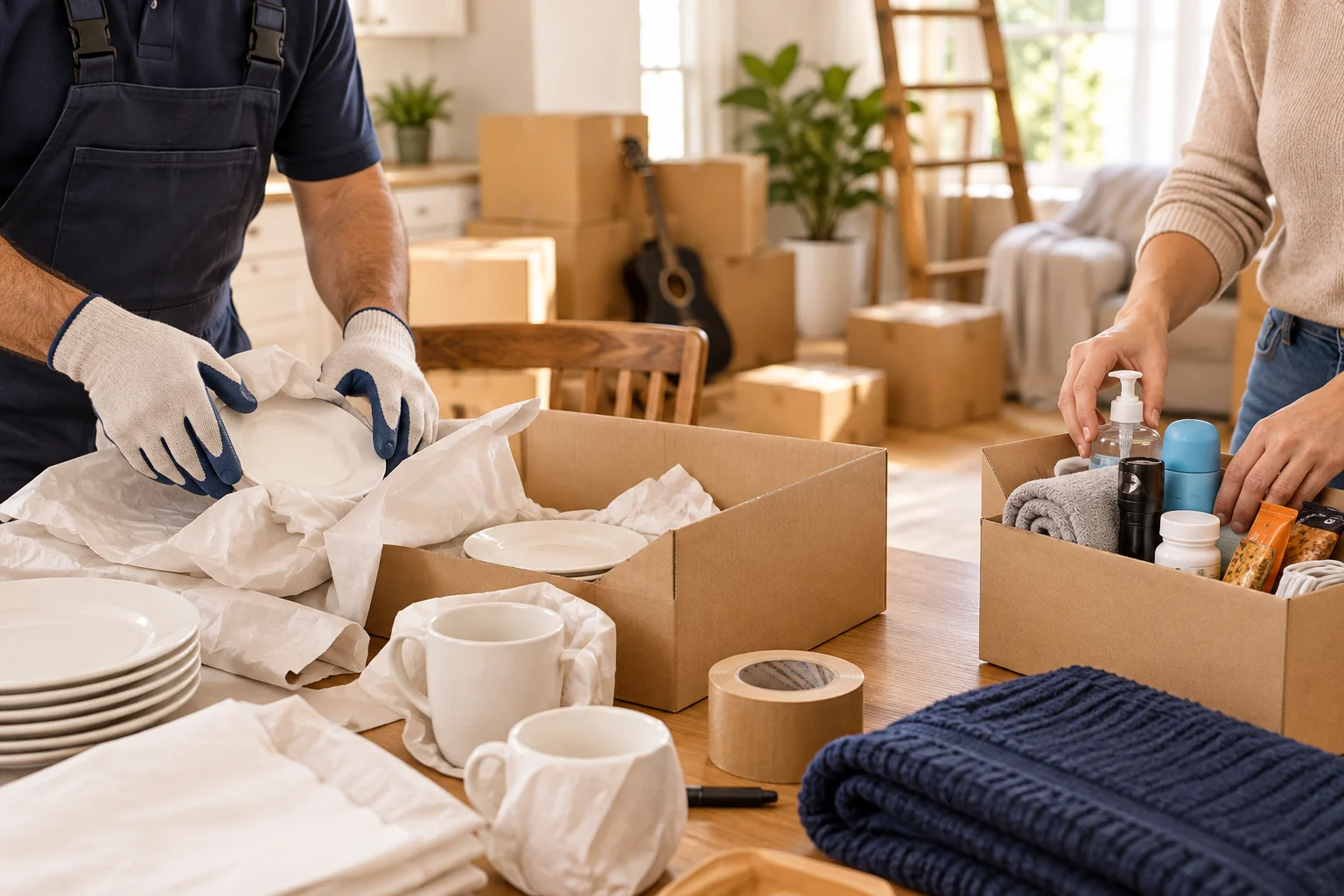
A trip of 800 miles or more exposes boxes to vibration and temperature changes, with handling at several points. Before leaving Atlanta, compare the time and cost of packing yourself with partial or full professional help. The scope you choose determines how you prepare.
Why packing choice matters more on a long-distance move
After the interstate truck leaves Atlanta, returning for forgotten goods or replacing damaged belongings is less straightforward than on a local move. Pack with the whole journey in mind.
Long-distance transport is priced by weight and volume rather than hourly labor. Packing affects truck space and therefore the charge. A carton that collapses or wastes space can add transport cost and leave you paying for damaged contents.
Self-packed boxes have insurance limitations that don’t apply to professionally packed goods. If their contents break, the mover’s liability is usually limited or nonexistent for that box. Include that exposure in the cost comparison.
DIY packing: time and material costs
You avoid the packing labor charge by doing it yourself. Materials still cost money, though, and the work takes your time. Include the damage risk you’re accepting.
For a two-bedroom home, set a professional packing quote of $800 to $2,400 against 15 to 25 hours of your work. DIY materials are roughly $75 to $150. The labor saving needs to be weighed against those hours.
| Home size | Self-pack time | Material cost | Professional packing cost |
|---|---|---|---|
| Studio / 1BR | 5 to 15 hours | $30 to $80 | $150 to $1,200 |
| 2 Bedrooms | 15 to 25 hours | $75 to $150 | $800 to $2,400 |
| 3 Bedrooms | 25 to 35 hours | $100 to $200 | $1,200 to $3,600 |
| 4+ Bedrooms | 35 to 50 hours | $150 to $300 | $1,800 to $5,000 |
Divide a $1,000 professional quote by 20 hours of DIY work and the comparison gives $50 an hour for your time. Spare time may make that worthwhile. Vacation leave or childcare changes the calculation, and packing after a long workday can make it less appealing.
The break-even question. If you’d pay $50 an hour for work you dislike, packing a two-bedroom home yourself for 20 hours can be a rational choice. A higher value for your time, or an inability to set aside 20 uninterrupted hours, changes how the professional quote looks.
Free boxes can lose their apparent saving if crushed corners leave glassware broken. Budget for double-walled cartons and protective wrapping, with specialty boxes for fragile goods.
When DIY packing saves money and when it costs more
The goods you pack and their effect on the rest of the move determine whether DIY lowers the total cost.
DIY saves money when
DIY can suit clothing and linens, along with books or other non-breakables. It works when you have several weeks, proper materials and few fragile or valuable goods, and are comfortable doing the physical work.
DIY costs more when
Rushed packing can leave collapsing cartons that slow loading and add labor hours. Fragile contents may break without insurance protection. Underestimating volume can also require extra truck space at the last minute.
Sealed, well-packed cartons let a crew load about 500 pounds an hour. Open or unstable boxes can lower that rate to 350 or 400 pounds an hour. Rewrapping or repositioning can turn a four-hour job into six or seven, and the extra loading time appears on the invoice.
The mover can refuse cartons that don’t meet packing standards until they’re repacked. That can require a last-minute supply trip and postpone pickup, with additional costs.
How packing affects your moving weight, tariff, and insurance
Long-distance transport charges use weight and truck space rather than an hourly rate. Packing affects both measures.
The goods account for the weight, so professional packing rarely changes the total significantly. Volume is another matter. Overfilled cartons or awkward shapes waste floor space, and unstable boxes do too. With cubic-foot pricing, that space adds to the charge.
Self-packed cartons are marked Packed By Owner (PBO). Most carrier liability policies exclude their internal damage because the mover can’t verify the contents or packing. Some cover PBO only for catastrophic loss, so a crushed carton that isn’t completely destroyed may receive no compensation.
What this means in practice. A cracked mirror in a self-packed carton may have no coverage. The same mirror packed by the crew is covered under the mover’s liability. Include replacement costs for fragile goods in your DIY comparison; a high value can use up the apparent saving.
Check whether the protection is basic liability or declared value coverage. Basic liability often pays well below replacement cost. Declared value offers broader protection but still requires documentation and has exclusions or filing deadlines. Self-packed goods may remain limited or excluded, so read those terms before packing fragile contents.
Partial packing vs full packing: criteria for choosing
Partial packing lets you handle the simpler rooms and leave difficult categories to the crew. It sits between packing everything yourself and hiring full packing.
Limited time can justify professional packing, as can fragile or specialty goods. A long-distance trip and difficulty with the physical work make it more useful too. If you can manage the simple rooms, partial service lets the crew handle kitchen goods or artwork, with glass and other difficult categories included as needed.
Professional help is particularly useful for fragile or valuable goods, including awkward shapes. Glassware and mirrors need appropriate materials, as do artwork or electronics. Every item the movers pack is covered under their insurance. For valuable belongings, that coverage can justify the packing charge.
Scenarios: which packing scope fits your situation
Family with young children
Packing around young children often means short working sessions over several weeks, without a guarantee you’ll finish in time. Handle clothing and toys yourself, with linens too. Leave the kitchen or electronics and other fragiles to the crew for moderate cost and protection of likely breakages.
Senior moving to be near family
For a senior, the savings can be outweighed by a fall or back injury. Lifting boxes and bending over dishes add risk, as do stairs. Full packing, or crew packing of all heavy and fragile categories, is usually the safer choice.
Young professional with a studio or one-bedroom
With fewer possessions and few fragile items, a studio or one-bedroom can often be packed over a weekend. Do clothing and books, plus basic kitchen goods yourself. Consider professional packing or proper cartons and wrapping for a TV or monitor. Glass furniture needs the same attention.
Downsizing from a large home
A DIY packing project in a large home can stretch over several weeks. Full packing often pays for itself when years of accumulated goods include fragile or sentimental pieces. Professionals can do it in one or two days, with less damage risk for irreplaceable items.
Box preparation and packing requirements
The following packing choices have direct cost or handling consequences.
- Using the wrong box size. Put books and other heavy goods in small cartons; use larger boxes for light bedding. A large box of books can be unsafe to lift or collapse, and the mover may refuse it.
- Overpacking boxes. Keep cartons below 50 pounds and fill gaps with packing paper or towels. Overfilled or heavy boxes risk breakage and unsafe handling; filling gaps prevents shifting.
- Waiting until the last minute. Begin with nonessential goods six to eight weeks before departure. Last-minute packing can leave items broken or disorganized, with essentials forgotten.
- Skipping labeling. Label each carton with its contents and destination room. Otherwise, finding essentials requires opening boxes and takes extra time.
- Ignoring the insurance gap. Fragile goods you pack yourself are usually not covered. Have the crew pack them, or include potential replacement cost in the DIY decision.
- Forgetting liquids and restricted items. Check restrictions on cleaning chemicals and paints, with aerosols or open liquids too. They may be prohibited. Packing them can cause leaks onto other cartons or prompt refusal of the shipment.
Pros and cons of packing scope
Partial packing works well when
- You can handle clothing and books, with shoes packed yourself too.
- You want professional help with the kitchen, glass, mirrors, artwork, and electronics.
- You are comfortable with a moderate time commitment.
- You want to reduce cost without absorbing all the risk.
Full packing works well when
- Your timeline is tight and you cannot dedicate 15 to 30 hours to packing.
- The home contains many fragile, high-value, or awkwardly shaped items.
- You are moving long-distance and want the highest level of protection.
- You physically cannot or prefer not to do the packing yourself.
What you keep with you
Keep medications and wallets with you during the move. Carry keys and important documents too, along with jewelry, phones and chargers. These can be difficult to replace and may be uncovered if lost in transit. Put toiletries and a change of clothes in a first-night bag, with the paperwork you’ll need on arrival.