
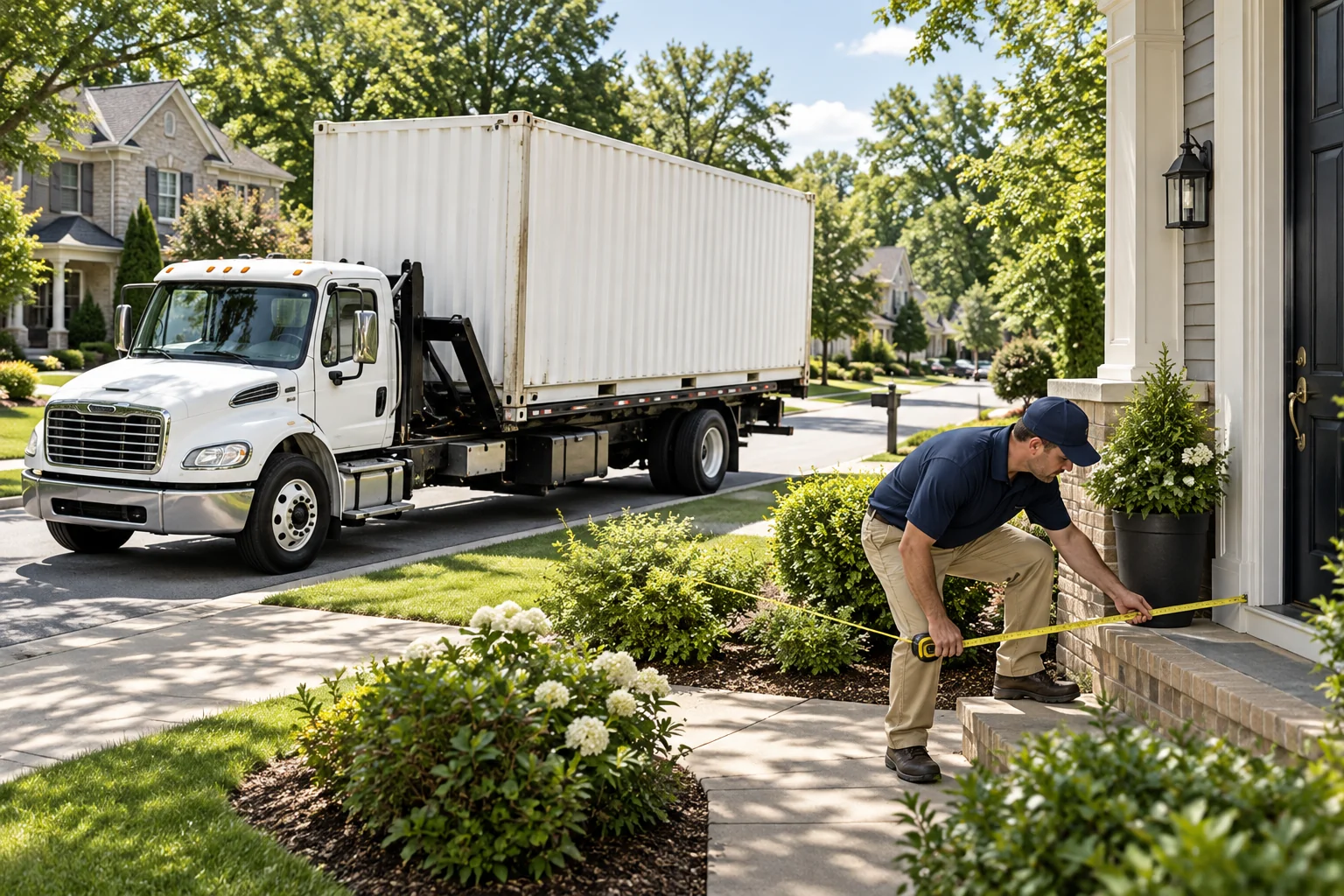
Before the mover finalizes your interstate transport plan, document the approach to both homes. A 53-foot tractor-trailer needs space on the street and driveway, with adequate overhead clearance. Use this checklist for the Atlanta pickup and the destination.
Why interstate trucks face different access rules than local moves
A local Atlanta move usually uses a 26-foot box truck, roughly 12 to 13 feet tall and about 8 feet wide. That truck can maneuver through most intown neighborhoods. Interstate equipment is larger: a 53-foot tractor-trailer stands 13 feet 6 inches high, and its overall length can reach 73 feet with the cab. It needs considerably more turning room.
Fitting a 26-foot box truck doesn’t mean the driveway will hold a 53-foot trailer; part of it may extend into the street. The interstate driver may also be unable to make a safe, legal three-point turn in a cul-de-sac. Branches clearing a 12-foot van can scrape a trailer a foot and a half taller.
Georgia’s legal vehicle-height limit on state roads is 13 feet 6 inches. For public-right-of-way activity in Atlanta, an oversize permit is required for loads exceeding 13.5 feet high or 8 feet wide, or a length of 55 feet. The federal interstate-highway standard is similar. A slope changes the trailer’s position relative to an overhead obstacle, so a driveway rising toward the garage can turn an apparently adequate clearance into a collision.
Check access for the actual road-haul equipment. A smaller local moving truck’s ability to reach the home doesn’t establish access for a trailer.
The access checklist: what to measure and check
Before setting the date or signing a binding estimate, inspect both properties with a tape measure and phone camera. The table lists typical interstate equipment dimensions and the property features to compare with them.
| What to check | Typical interstate truck measurement | What it means for your property |
|---|---|---|
| Street width | 8 feet 6 inches wide trailer | A street narrower than 20 feet between parked cars leaves no room for the trailer to pass without mounting the curb or blocking traffic. |
| Overhead clearance | 13 feet 6 inches on flat ground | Tree branches, low wires, bridge underpasses, and parking deck entrances below 14 feet are immediate blockers. The truck cannot duck. |
| Driveway grade | Air-ride suspension, but limited approach angle | A steep transition from street to driveway can cause the trailer to scrape its underside or lift its rear wheels off the ground. |
| Turning space | Roughly 55 to 60 feet of curb-to-curb radius for a 90-degree turn | A tight cul-de-sac, a narrow T-intersection, or a driveway with a sharp angle may require the driver to back in from the street, which needs even more room. |
| Driveway length and width | Trailer alone is 53 feet long | A driveway shorter than 60 feet from the street to a turn may leave the trailer blocking the sidewalk or a neighbor’s access. |
| Weight restrictions | Loaded trailer can exceed 40,000 pounds | Some residential bridges, older culverts, and private roads have weight limits below what a loaded interstate truck weighs. |
Find the street’s narrowest usable point. Measure the driveway entrance and any gate, then the space near the garage or parking pad. For a slope, estimate the grade with a level or phone app. Photograph low branches and utility wires. Include mailboxes or decorative gates, tight turns and the cars normally parked along the street.
How to check access before you buy or rent
A pending lease or home sale needn’t delay the preliminary access check. Start with the property images already available.
In Google Maps, open Street View for each address and follow the approach a driver would take. Check road width and parked cars, then the tree clearance and driveway entrance. Images are often several years old and won’t show recent growth or construction. They can still reveal permanent narrow bridges or low overpasses, along with sharp turns.
Find the gates in satellite view and look at driveway length, then nearby structures. For a gated community, ask whether commercial vehicles use a service entrance. Many HOAs direct moving trucks away from the resident gate; that alternate entrance may be narrower or lower.
For an Atlanta property, consult the city’s bridge inspection information and the Georgia Department of Transportation bridge inventory for posted limits. A height limit below 13 feet 6 inches or a weight limit below 40 tons may rule out that route for the road-haul truck.
When choosing between two homes, consider the approach as well. A wide street and long, flat driveway make moving easier than a narrow hill with a low oak at the entrance.
Checking the origin side: what people forget
The truck has to load at your current home before it can deliver to the next one. Give the origin the same access check; it may be just as difficult.
Check move-out rules with the building in Midtown or Downtown, and in Buckhead too. Most high-rises need a Certificate of Insurance and a reserved freight elevator, sometimes with a damage deposit. If the elevator slot isn’t long enough to load safely, the job may continue the next day.
Older intown walk-ups may have no elevator or loading dock. Legal parking near the door may also be unavailable for a 53-foot trailer. If the driver parks a block away, the crew has to carry each item that distance. Include the extra labor hours in your planning.
A five-minute call to the leasing office can prevent a wasted trip. Ask about move-out rules before booking, including required notice and any weekday-only hours. Some buildings also prohibit truck idling outside.
What to photograph and send to your mover
Send photos of both properties before the estimate is finalized. The driver handling your shipment needs a visual record of the approach and unloading path.
1 Street approach
From across the street, photograph the approach in both directions. Show the usable road width and parked vehicles, with overhead obstacles in view.
2 Driveway entrance
Photograph where the driveway meets the road, showing the slope and curb. Include any drainage channel. For a gate, take views from both sides.
3 Overhead clearance
Photograph branches and wires crossing the approach, as well as overhead structures. Include a tape measure or an object of known size to show scale.
4 Turn radius
Show the intersection or cul-de-sac where the truck must turn. Include any hydrant or parked car restricting the space, along with a mailbox if it affects the turn.
5 Destination door
Photograph the route from the parking position to the unloading door. Show stairs and narrow passages, including any sharp corners.
6 HOA or building rules
Photograph the relevant pages of the building’s or community’s move-in packet. Send the written rules so the mover can review the actual requirements.
Send the images and ask whether the road-haul truck can reach the property or needs a shuttle. A reputable interstate carrier will review them and give you an answer before dispatch.
Access details to check beyond Google Maps
A map image doesn’t reveal every access condition. Some become apparent only when a loaded truck approaches.
Cars crossing a residential bridge don’t establish access for the trailer. A posted limit of 15 tons can sit below a loaded interstate trailer’s weight, and culverts need checking too. Consult Georgia Department of Transportation inspection records and local restrictions that may be missing from navigation apps.
Utility wires may sag with age. A power or communication line installed 16 feet above the road may sit at 13 feet after a decade of heat and ice. Not every private-driveway situation requires the utility to maintain a particular clearance, so include wires in the access assessment.
Public databases may not include restrictions on a shared private lane. Ask about its weight and width limits, and whether the turning space was designed only for passenger vehicles. The HOA or road-maintenance agreement may contain the details.
Will the approach be usable in the season you’re moving? A driveway firm in July may be soft and rutted in February. Snowbanks can narrow an otherwise accessible street. Discuss winter or early-spring conditions with the mover.
If the truck cannot reach: shuttle, long carry, and additional labor
If the main truck can’t reach the home, the carrier has several ways to complete the move. Compare them when planning the delivery and budget.
| Solution | How it works | When it makes sense |
|---|---|---|
| Shuttle service | The shipment is transferred from the 53-foot trailer to a smaller truck at a nearby accessible location, then delivered to the door. | The destination street is too narrow or the driveway too tight for the road-haul truck, but a smaller vehicle can reach the property. |
| Long carry | The road-haul truck parks at the nearest legal and accessible point, and the crew carries every item the additional distance to the door. | The truck can park reasonably close, but not in the driveway. The extra distance is manageable for the crew and the weather is not extreme. |
| Additional labor | More crew members are added to handle the extra distance, the transfer, or the stairs. | The carry distance is long, the items are heavy, or the move involves multiple flights of stairs. |
| Alternate delivery point | The shipment is delivered to a different location that the truck can reach, such as a nearby storage unit or a neighbor’s driveway. | The destination property has no accessible point at all, or the customer can arrange a secondary transfer. |
The Federal Motor Carrier Safety Administration uses “impracticable operations” for situations where normal road-haul equipment can’t perform pickup or delivery. These additional services fall under the carrier’s tariff. A shuttle or long carry may add a charge if the access condition wasn’t disclosed before the estimate was finalized.
A narrow street or steep driveway disclosed before booking lets the mover schedule a shuttle and put its cost in the estimate. Finding it at delivery means an unplanned arrangement that costs more.
Atlanta area differences: intown, suburbs, and HOAs
Check the actual approach in each Atlanta neighborhood. A truck that fits one location can be blocked at another.
| Area | Typical access conditions | What to watch for |
|---|---|---|
| Intown Atlanta | Narrow streets, on-street parking, mature tree canopy, older infrastructure | Streets in Virginia-Highland, Inman Park, and Old Fourth Ward can be too narrow for a 53-foot trailer to pass when cars are parked on both sides. Tree branches often hang low over the roadway. |
| Midtown and Downtown high-rises | Loading docks and freight elevators, but strict building rules | Most buildings require a reserved elevator and a Certificate of Insurance. Street parking for the truck is rarely available, so the load runs through the dock. |
| Close-in suburbs | Driveways, wider streets, fewer overhead obstacles | Decatur, Sandy Springs, and Brookhaven are generally easier, but individual streets may have permit parking or HOA restrictions. |
| Northern suburbs and HOA communities | Gated entrances, private streets, HOA move rules | Marietta, Roswell, and Alpharetta communities often require advance notice, restrict move hours, and designate a specific gate for moving trucks. A gate that is wide enough for a car may not be wide enough for a trailer. |
| Rural or semi-rural outskirts | Long driveways, unpaved surfaces, limited turning space | Gravel driveways can be too soft for a loaded trailer. Long driveways may lack a turnaround, forcing the truck to back in or the crew to carry items a long distance. |
Obtain the HOA’s requirements for truck size and parking, including moving hours and notice. Georgia associations can impose those rules, and some prohibit commercial vehicles beyond a stated length. They may also require a Certificate of Insurance or a deposit for common-area damage.
Request current move-in or move-out rules in writing before scheduling. Send them with your property photos so the mover can determine whether the road-haul truck may enter or needs a shuttle from the gate.
When access problems change the price
Reaching both homes without special equipment or extra labor is one of the estimate’s assumptions. Different access conditions can therefore change the price.
A shuttle requires unloading the trailer and loading a smaller truck, then driving to the home and unloading again. The transfer needs more labor and time, often with another vehicle. A long carry increases the crew’s walking time; additional labor puts more people on the job. These charges cover work outside the original estimate.
Disclose access before the estimate is finalized. Send photos of the street and driveway, including the gate and overhead obstacles. If dimensions aren’t known, say so and request a remote review. Many carriers use satellite images alongside Street View and your photos.
If the destination address isn’t settled, tell the mover that access is still undetermined. Send the address as soon as you have it and request a review before dispatch. That early discussion generally leaves time to adjust the plan.
Pros and cons of different access solutions
Compare the access solutions against the actual obstacle. Their costs and handling requirements differ.
Shuttle service
- Reaches properties that the road-haul truck cannot access
- Keeps the shipment on schedule when the main truck is blocked
- Reduces the risk of damage to the truck or the property
- Adds cost beyond the original estimate if not disclosed in advance
- Adds a transfer step, which increases the chance of handling damage
- Requires scheduling a smaller vehicle, which may delay delivery if not arranged early
Long carry
- Avoids the cost and complexity of a shuttle
- Works well when the truck can park reasonably close
- Keeps the shipment on the same vehicle from origin to destination
- Adds labor hours, which can be significant on a large shipment
- Increases the risk of damage during a longer carry
- Is not practical in bad weather or over very long distances
Additional labor
- Speeds up a long carry or a stair-heavy delivery
- Reduces the physical strain on the crew, which can mean fewer mistakes
- Can be added on moving day if the job is running long
- Increases the hourly cost of the move
- May not be available on short notice during peak season
- Does not solve the problem if the truck physically cannot reach the property
For a street that won’t fit the trailer, a smaller truck can shuttle the shipment to the door. Nearby legal parking may instead allow a long carry when the driveway is too steep. Add crew for a heavy shipment with a long carry if that makes a one-day job possible rather than two days.
If no truck can reach the home, the last leg requires a smaller-vehicle transfer or carrying goods by hand. A footpath or staircase may create that situation. A bridge unable to carry any loaded truck can do the same. Discovering it early gives you more options.
FAQ
Before you book: Take measurements and photos at both homes before dispatch. Record the street and driveway dimensions, with the gate and overhead clearance. Ask the mover directly whether its road-haul truck can reach each property or needs a shuttle.